How to use AV to escape from textbook addiction
The fact of a fatal compromise in the original impetus to build the new school around the library could no longer be ignored by my fifteenth year in the school. That was the year it was finally decided that a full salary could no longer be allotted to the position of librarian, given the new era of financial accountability. I found myself back in the classroom as a half-time teacher of history. There was reason to suppose that perceptions born in the new computer fad played some part in what I viewed at first as a serious setback, if not the beginning of the end of the library as a defining element in the comprehensive school, however illusory that had been.
The demotion, as it first seemed, was soon to be a pattern common to public education in Saskatchewan as educational funding became more austere, and full-time librarians led the parade of expendable educational luxuries. One can only speculate on whether the apparent decreasing emphasis on expository communication in general contributed to making part-time librarians seem a serviceable option. Certainly the stereotype of librarians as Keepers of Books has led many Directors of Education to assume that a clerk with a computer can often be substituted for farm work. Parallel developments, such as reductions in the traditional compulsory status of English and History, and a casual farming out of writing instruction "across the curriculum" may yet turn out to be part of a pattern emerging from the computer revolution.
Be that as it may, the partial return to the classroom did more than give me a career opportunity to test my communication theory in practice; it led me also toward teaching history through television, using the medium as a teaching vehicle rather than a sometimes aid, something which I might not have done otherwise in the isolation which was increasingly a factor in the librarian's position . The Mafia had reacted to external pressures again, without intending to do me a favour, but they had inadvertently revived my career. Having pressed for years the central role of library print and audiovisual resources in promoting literacy, I now had to practice what I had been preaching. Unless I could make writing and viewing a defining characteristic of my own practice, I could hardly berate anyone else for not doing so.
There are a number of general principles which ought to shape any approach to the teaching of general world history in high school. First, it is necessary to identify some controlling and unifying ideas which enable the student to interpret rather than memorize, and to anticipate or even predict at least general global social and political trends. Secondly, it should be possible, given the controlling ideas, to assign some order of importance to individual facts, since facts which are not central can be useful in filling out the picture and adding color. More important, we need to know which facts are dead weight, best ignored because they are either superfluous or of only pedantic interest. It may be that as little as 2O% of what teachers usually consider appropriate for a high school history course is really worth attention, with 80% contributing mainly color or completeness.
There are good scientific reasons for limiting the concepts which can be introduced, as we considered in the discussion on Wood's General English. I chose Power and Change because these general themes would allow me to trace the general engines of change, as it were, which have created a tendency for power to diffuse out and downward, in most societies, and have allowed some cultures to better serve their own interest, become dominant, open new vistas of mind and spirit, create wholly new social, political and environmental problems, and shape the world all cultures must come to terms with. Thus the purpose of teaching high school history is to make clear that History is not a sequence of fortuitous events, to be studied because it is there, but a broadly predictable and coherent process so important that its traditional parity together with English and Mathematics/science in defining a liberal secondary education is made intelligible. We are to manage this, however, without attempting to force adolescents to memorize a Fact One to Fact 849 textbook Weltanschauung complete with politically correct snippets from geography, religion, economics, and politics. I had also to put together a pattern of causal explanation which, while avoiding violence to reality, allowed me to teach without going over my students heads.
I am not concerned in the first instance with disputing whether some societies are culturally or morally superior to others, even if such disputations make sense. It is more important that the study of history show how some societies acquire the power to shape their fate for good or ill, and others lose it, before we can decide whether some outcomes are preferable to others. If there is any point to history as a high school discipline, it must yield some powers of interpretation for better students and at least an appreciation of the importance of history in the average.
Being able to articulate knowledge of historical concepts in formal writing assignments is the most practical way a teacher has of determining how well the student has acquired a capacity to interpret history, and I will shortly describe how a book review from an appropriately designed library reading list can produce genuine, non-plagiarized results for the history teacher. That takes care of the print application; we now will consider a way of making television a vehicle for an understanding of history which can allow teachers to escape from a Fact One to Fact 849 fixation and thus finally tap a potential which that fixation has smothered for so many years.
Establishing a framework for Power and Change
Establishing the basic concepts of Power and Change required beginning both Grade Ten and Grade Eleven with study units on these concepts, not in abstraction but in the appropriate historical context. In Grade Ten this meant three to four weeks devoted to the economic and social characteristics of Feudalism, with glances at the Roman world before the barbarian invasions and the Dark Ages which followed. "Glances" is an appropriate expression, since there was no need to refer to a textbook at all. There are also a number of good illustrated books available to supplement video programs, and in my approach one never needs to place much emphasis on a textbook if there is adequate AV available.
In studying the Middle Ages one examines a society in which the division of rich and poor was perceived as a permanent, unchanging realization of the Divine Purpose as revealed to the Roman Catholic Church. As we proceed, we begin to take note of the fact that change was bound to occur regardless of the best laid plans of gods and man, and it will be instructive and interesting to see why this is so.
Power involves the capacity to shape the world. In the western world, this meant more than the mastery of enough technology to keep the body comfortable while allowing the soul to seek immortality. The contrast between the West and East historically will involve, among other things, a distinction between science and technology and mysticism. The point is not to determine which is more satisfying or ethically superior, but to stress that Power is a practical rather than spiritual matter. We will deal, much later, with the modern drive in Asia to catch up with the West in technology, and adapt their social and religious life accordingly. The world is not built the other way around, and I liked to point out to my students that our ultimate object was to find out why they speak English and why most of the people in the world who are starving don't. (it is revealing that the Chinese invented fireworks; gunpowder was perfected when Europeans realized that if one placed the powder in a iron barrel with a projectile it would be possible to blow rival's heads off).
It will be too soon to mention the distinction between "real" war and "true" war, where the aims and customs of primitive societies generally limited the destructive effect of warfare to a small warrior element in a society by confining it to individual plunder and cruelty (real war). (11) The modern European conception (true war) began with the Romans but owes something to Arab and Mongol influences in particular, and saw warfare as a political extension of state policy, subordinating the individual to the perceived overall power and status of the community. True war, given the technological edge of Europe over the centuries, made less advanced cultures the losers, particularly during the period of great European expansion. The disastrous downside of technological efficiency will not be fully evident until World War I, when technology was turned in upon combatants who shared a level playing field.
I liked to begin by spending one lesson on a day in the life of a well-to-do Roman. Aside from some interesting insight into the origin of gourmet tastes in cooking and some inevitable student inquiries about Roman orgies (which can be touched on, and some misperceptions corrected to advantage) the purpose is to take note of a world with one government, one currency, one financial and military system, and one religion, and to contrast this with non-European models in one overriding respect: non-European cultures were wont to ask how should one live in order to achieve spiritual unity with some transcendental reality; the Roman and thus Western genius lay, in part, in a practical insistence on how things work. (Other key elements, such as geographical isolation and the related hegemony of a conservative priestly class will be worked in later when we are able to ask why the Chinese ruling class was successful in curbing social change and the Catholic Church was not.)
There are two key elements in this very brief allusion to the Roman world which will be of use later: first will be the reasons for the decline of the Empire, and, secondly, the appearance of the mounted soldier, or cavalryman, which is causally related to the decline. It will be our first glance at the technology of the battlefield, which throughout history is one of the more useful avenues to understanding the structure of societies. We will not flesh out the picture fully until the role of chivalry in medieval knighthood is explored, but a half hour spent on the Roman infantryman will begin a thread which will help to enliven and unify.
The Roman era was built on the farm boys who manned Rome's infantry, and the Roman army was a professional force serving for pay and citizenship, subordinating personal gain for community purposes and morality. Given the right purposes and morality, such a force can be an essential component of civilization, a fact which should eventually emerge from our studies by the end of Grade Eleven. In the meantime, we will note only in passing that the Roman taste for cruelty was exceeded only by the Mongols and Vikings.
This essential base of Roman power was eventually eroded in part by the importation of cheap foreign grain. That no empire has ever survived which impoverished its farming class is a point well appreciated in a rural community, where farm boys traditionally are used to long hours, hard work and doing without, all elements which produce good foot soldiers. We will examine briefly the basic equipment of the Roman infantryman, with emphasis on the use of the pileum, or short spear, and the pike, short sword, and interlocking shields on which barbarian cavalry charges usually wrecked. A reference to Viking infantry and their cavalry destroying broad axes will reinforce the puzzle as to why the knight became the military archetype during the Middle Ages.
The image of medieval soldiery centers around the mounted knight, a descendant of the barbarian cavalry which over-ran the Empire in its last days, after the decline of Roman infantry had led to the defense of the frontiers by mounted mercenaries hired from among the barbarians themselves. The mounted soldier survived as a feature of medieval society, but only because he was an expensive status symbol unchallenged by competent opponents. At this point, however, we will only illustrate the two arms of cavalry, both heavy and light, and infantry, perhaps only hinting at the question of relative supremacy. Only when we turn to the Battle of Agincourt in 1415 will we address directly the question of military technology and what it reveals of the nature of feudal society.
We begin with the classical division of feudal society into those who prayed, those who fought, and those two worked (and paid the taxes). Wealth is land, and the landowner dominates the first two groups either as a soldier or as a clergyman. The mechanism of change in the pre-industrial static world is crude and simple: in an unchanging environment based on the annual cycle of harvesting and distribution of crops, change can only occur in the division of existing wealth between the haves and have-nots. Class conflict is the basic form of change in a society where the only matter to be resolved is the ownership of a relatively stable quantity of wealth. This basic model of change will be superceded only with the Industrial Revolution, when technology assumes a life of its own as an engine of change, largely replacing the class conflict which led to the demise of Church and Kings.
The foregoing line of interpretation is assumed in almost any good modern AV program, although some of my colleagues somehow got the idea that it is "Marxist". Marx, it is true, is considered the founder of modern sociology, and we will consider his achievements and mistakes during the initial Change unit in Grade Eleven, in particular the mistake of extrapolating class into an age of technology. At the beginning of Grade Ten, however, the following is taken as the model for change fundamental to the Middle Ages:
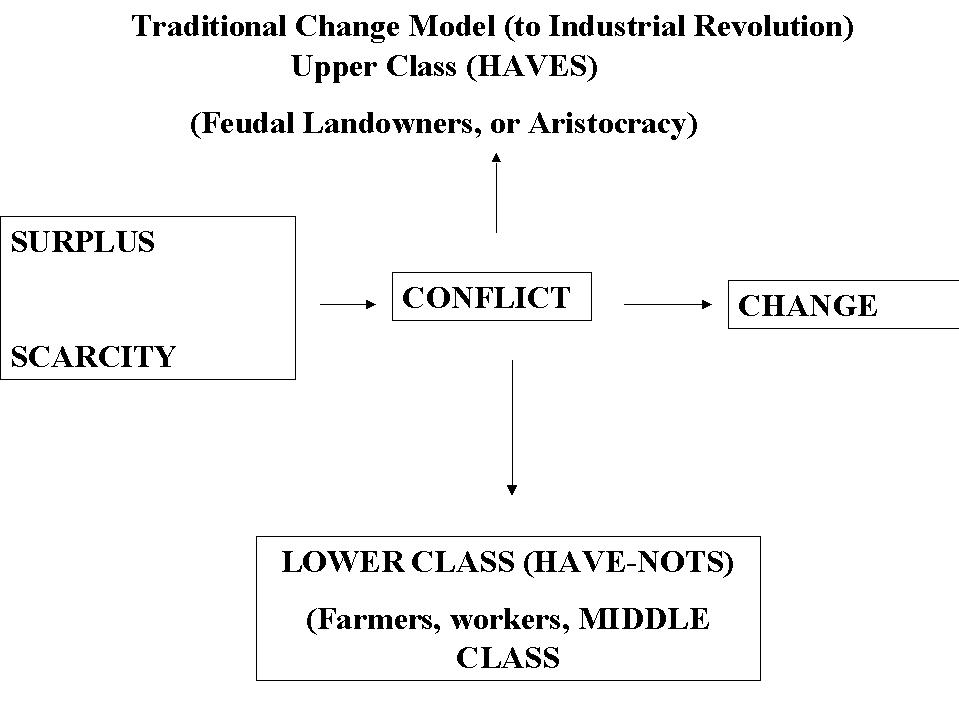
Civilizations arise when it becomes possible for people to produce enough wealth to allow some of the population to engage in activities other than food-gathering. Inevitably, the "surplus" which allows for this condition is also "scarcity" for the majority, since the strongest, cleverest and quickest will monopolize what is available and hence will determine the shape of the society.
Appendix C is an annotated list, roughly in the order I would expect to use them, of the video programs which I had access to in developing the units on Power and Change. I liked to begin with "The Grain in the Stone", the first in the Ascent of Man series featuring the late great Jacob Bronowski. Here Bronowski explores the conceptual leap between merely shaping what nature provides and the shearing, cutting action of the human hand in order to create something new. He links this to the creation of agriculture and the technology of the medieval cathedrals, together with the social apparatus they presumed. He even shows how the fragile centralization of power among the Incas proved fatal before the more flexible and adaptable Europeans, whose society was already adapting to economic, technological and political change. (This latter concept will be only hinted at now).
Bronowski does glance at the technology of the Greeks and Romans, and it is useful to make the connection with the concept of change: the practical bent of the Roman genius for organization and government was to prove a better foundation for the emergence of technology and change than the mysticism of the Greeks and Eastern worlds.
But there is a problem with Bronowski: each episode of the Ascent of Man is an hour in length, and this poses a problem for the Grinder, who is addicted to using AV simply for the purpose of illustration. While it is common among Grinders to downplay AV as largely entertainment, and to suspect teachers who use AV extensively as trying to avoid the effort of teaching and preparing lessons, the fact is that it is quite impossible to get away with running AV continuously past students. It is simply not their preferred TV fare, and the lazy teacher will soon pay the price.
Downplaying the use of AV (except for sound filmstrips and some radio and sound recordings this effectively means TV) is common in a textbook-oriented classroom, where teaching too often centers around the drudgery of ensuring that all students have written down similar answers to general questions. Yet the appeal of Bronowski and James Burke (The Day the Universe changed TV series) is that they are in touch with what makes history tick, and thus are inherently interesting in spite of program length. How are we to bring this out?
The answer is simple: we break the program into bite-sized pieces, digesting each segment thoroughly before moving on to the next. Digesting implies having an eye to making the connections to the general themes of Power and Change which, happily, these programs reflect. Any good program will have logically discrete segments, so it will not be difficult to insert a break where the teacher sums up what has gone by and anticipates points coming up. To do this it will be necessary to rivet the student to the screen, so that the alternation between screen and discussion will enhance, not decrease, interest.
My solution to this problem was influenced by Wood, who had in turn been impressed by studies (12) which described the passive neurological state of people staring at TV screens, and the learning problems which were appearing. Wood felt that the postage stamp AV screen resulted in a lack of eye movement, a problem which aggravated the negative aspects of TV viewing, unknown in the era of the 16mm screen. Large screen TVs were neither available nor economical at the time, but I could still devise a scheme which would keep a student actively involved in note-making in a practical way, and, better yet, keep him on top of the subject.
My innovation was a fill-in-the-blank system for both textbook and video, where the structure and content were contained in statements with key words omitted, and students had to complete the notes as they watched or read. In video note-making, this meant that they would have to attend closely to what was passing on the screen, pick up the piece which completed the information bit, scan the next statement to be completed and return to the screen. Part of the Grain in the Stone segment follows:
The Grain in the Stone -- Film 50 min
1. Civilization began later in _____________than in Europe because the continent had only been occupied through_____________.
2. Native populations crossed into America _______ years ago.
3. Two fundamental methods of forming objects by hand are shaping and __________.
4. Striking rather than shaping made________ possible.
5. The Pueblo people made the first city built entirely of __________.
6. Macchu Pichu is a perfect example of this type of city. It was discovered only 50 years ago in the high______ of South America.
7. Foods grown in the high Andes included_________ and ________.
8. Agriculture by the Incas was based on ___________.
Video notes are deliberately simple. It is important not to have too many blanks, lest the student be reduced to following the notes and merely listening to the program. The idea is to lead students into attending to what is going on, not to press them to feats of hand-eye dexterity. There will dividends later for class discussions. Here we are looking at the basic concept of a civilization.
Filling out the connections with Power and Change is up to the teacher, who must have an eye to when this is most appropriate. What is needed at this point is only a reference, an anecdote, a flash of insight, rather than a lecture. Later, the condensed textbook notes will furnish the narrative line needed to keep us on track and prevent the themes of Power and Change, warfare as a cultural expression, and technology and Intolerance, from becoming cancerous and exploding into new independent subject matters, which will only invite grinding again. The teacher has all semester to fill out the picture, so it is unnecessary to attempt everything on the first opportunity.
It is this power over nature which provides the basic material for surplus/scarcity scenario, allowing one class to dominate others and divert wealth to government, science, art and gracious living. That is all that need be established now.
Other questions will advance the concepts as we proceed:
10. Pizarro conquered the Inca Empire by simply capturing the ________ or king. (Inca--what does this tell us about Inca culture?)
11. All civilization rests on a basis of_____________. The trades (ironmonger, coppersmith, goldsmith, etc) require a high level of ___________. Why?
(agriculture, prosperity: so that surplus wealth can be to
to uses beyond mere survival)
It will be unnecessary to belabor the concepts at this point. It may be even unnecessary to turn the classroom lights back on unless an extended discussion develops or a more lengthy emphasis or recapitulation is required as the concepts become more complicated. (It was my practice to leave the Venetian blinds sufficiently ajar to allow for effortless work without allowing light to interfere with the view of the screen, so that much time was spent in class with the lights out).
Normally a video of this length would require half of a following class period to complete. So far from being a problem, this approach allows for a key point or two to be reviewed the next day before going on with the program.
Where is the textbook? It won't appear until we begin treatment of the Renaissance, which, apart from a revival of scholarship, represented a sea change in technology, trade, scientific knowledge and innovation, each a building piece in remaking the world for good and ill. When the textbook does appear, it will be handled in exactly the same way, with a fill-in-the-blank abstract which will be left for the student to fill in on his own. (13)
The textbook will still be useful in providing a narrative line, but, unless the purposes of review or emphasis otherwise dictate, introducing the text into the classroom routine will not be necessary unless adequate AV is lacking. This is how we will go about making time for the AV resources. I would indeed occasionally conduct a spot check to catch anyone who was not keeping the reading up, but the method was so natural that it was unusual for students not to be current, and good students could finish a week's worth of reading in a hour with the prepared text, scanning the full passage in the process but focusing only on the abstracted detail.
Whether student notes are based on AV or text, it will be necessary to exercise care in building them. Each AV program should be a complete whole and a link with the general themes established, as should each section of the text, and I sometimes placed brief capitalized editorial notes in the student outlines where the link with the general themes of Power and change needed to be made explicit. This practice will become more useful later on when plots thicken. No text or AV program, however adequate, will meet teaching requirements at every point. This is easily remedied by gradually putting together a teacher-produced manual to accompany the other materials, and by encouraging students to keep notes, in their own words, of themes and concepts which help to unify the material.
Chivalry and the Gentleman Soldier: Feudal Conflict and Change
The classic picture of the knight is that of a feudal figure who offered protection from barbarian invaders in return for a grant of land and service from the lower orders. This arrangement was sanctified by the Church, which taught that this life was a trial, a Vale of Tears, to be gone through in hopes of an eternal reward in Heaven. It taught that all men are equal in that they are all vassals bound ultimately to Jesus Christ, and that even Heaven was organized along feudal lines.
There are a variety of excellent AV programs which will not only fill out the above picture, but also show how flawed it was. I liked to use an old Encyclopedia Britannica film on medieval knights for a charming if superficial version of the traditional account, followed by a British production on the peasant revolt of 1381 in England. It was an effective way of bringing the discussion down to earth and introducing a more accurate figure of the knight whose protection, as often as not, was closer to that offered by Al Capone than to the idealistic picture of a romantic figure who fought for justice and wrote poetry to his lady-love. The traditional image also suggests, misleadingly, that the era of the mounted soldier ended with the introduction of firearms, when specialists were no longer needed.
The real problem with knighthood was the knight, as we shall see.
Exploding the traditional picture is a surefire way of catching student attention and alerting them to the fact that there is something of value to be learned from correcting the historical record. If they pester other teachers who still treat Chivalry as a romantic phenomenon rather than as a military code, so much the better. There is value, too, in exploring the exquisite taste for cruelty characteristic of the Middle Ages. (14)
In Grade Eleven the class will encounter the code of Bushido, the Japanese Samurai version of Chivalry, which determined the conventions which bound the life of the professional soldier. Chivalry will be recalled at that time, but, for the present, we will be concerned with the application of the code on the field of battle.
Chivalry prescribed the conventions which governed individual combat between gentlemen. Farm boys quickly appreciate why this had to be so for heavy cavalry equipped with lances, since the idea of masses of horses and men charging into each other, with results similar to what would happen if they were all driving Mack trucks, was an occasion for some amusement. The undisciplined commoner rabble which made up medieval infantry was usually slaughtered for sport later, as success or failure of continental military campaigns in the Middle Ages seldom turned on the use of infantry, at least until the coming of the English yeoman.
Secondly, gentlemen seldom took orders from other gentlemen on the battlefield, reserving the right to leave it if any traditional privilege or custom was denied them. Thus medieval strategy was all but non-existent, medieval armies being rather more akin to mobs than military formations in any modern sense. The horse and paraphernalia were essentially status symbols, the expense and training that their maintenance required being beyond the means possessed by rabble. The success of medieval cavalry depended on one's noble adversary being equally handicapped or incompetent.
One can here examine the relative strengths of medieval heavy cavalry and the light cavalry of the Arabs and horse peoples from the steppes of Asia (Huns and Mongols), anticipating the growth of national states whose power, especially with the advent of gunpowder, came increasingly to rest on regular professional infantry, as it had with the Romans. Light cavalry could not defeat heavy cavalry at close quarters: it had to use its speed, and the composite bow, to engage in hit and run tactics. The result, as we will note in referring to the crusades, was usually a draw. However, while heavy cavalry was helpless in charging a fixed infantry position, as we shall shortly see exemplified in the Battle of Agincourt, light cavalry sometimes could use its mobility to break into stationary infantry squares or break them up before they were formed. It became a case of paper covering rock, rock crushing scissors, and scissors cutting paper. The insights thus gained will be useful later in tilling out the picture of the rise of Europe to world dominance.
All these matters emerged during my "grabber" lecture on the Battle of Agincourt. I refer to it thus because, effectively done, a review of that encounter will keep almost any group hanging on the teacher's words, and provide the first step in showing how the conventions which determine how a society lives and breathes can be identified in the day to day events of social life, beginning in this instance with the use of technology on the battlefield.
Agincourt, 1415
Contrary to popular notions, knights, especially in continental Europe, were essentially lawless, and a little rape and pillaging between battles was always in order. Peasants who did not buy the "pie in the sky when you die" vision of the purpose of human existence might need to be put down too. Grinders, asked for the purpose of castles, for example, invariably reply that they were needed to protect people from depredations of the barbarians, a point which appears even some old AV. No one thinks to note that the first castle appeared in Europe about 1000 AD, nearly 600 years after great migrations which brought down Rome. Castles in England not exist until the arrival of the Normans, and were built protect people, usually knights, from other knights.
Some say that Henry V was in France at this time on a raid. Perhaps because the tangled family relationships of feudalism related almost any royal family to any other in Europe, an English adventurer could always claim to be merely seeking his heritage by pursuing the throne of France, or whatever real estate he could lay his hands on.
At any rate, the operations of 1415 had ended with the onset of fall and winter, as medieval campaigns always did, since armies could not expect to live off the then meagre resources of the land. Henry was at Harfleur, on the French coast, but rather cockily decided to march across the French countryside to Calais, the better to thumb his nose at the French by showing that an English army could march anywhere in France with impunity.
The weather was cold and rainy, and many of Henry's men were suffering from dysentery. French units began to follow them, and by the time Henry's army reached the Somme (We will file this away for recall in Grade Eleven, World War I) he was being trailed by 25,000 French knights. The French formations, of course, were landed gentlemen eager to come to grips with their social and military equals on the British side.
But while the French were a purely feudal army, the English force was much closer to professional calibre. Only 2,000 English were knights; 4,000 were longbowmen, commoners skilled in the use of a fearful weapon which had inflicted much grief on the French already at Cressy and Poitiers. Curiously, the French response had not been to adopt the weapon, but to try to make their armour heavier, a futile effort against a weapon which could penetrate medieval armour at 300 yards.
The English longbowmen were independent farmers, or yeomen, who were expected, as a condition of their status, to spend a portion of their time gaining proficiency in the use of their weapon. Feudal France had no comparable class, and most of their agricultural workers were impoverished serfs. The French did have a small force of commoner crossbowmen, wielding a hunting weapon outclassed by the longbow in both range and rate of fire, but the nobility seldom associated with their social inferiors, and the crossbowmen never got into action at Agincourt.
The French had learned from the earlier disasters to dismount and fight on foot as the English did, but the pride of the French army was still its cavalry, which flanked the French battles, or echelons, as they closed on their adversaries. The English army, never that numerous in France anyway, had learned early to fight as infantry from a fixed, or prepared, defensive position, goading the French gentleman into attacking, eager to claim the glory of besting a noble English counterpart. Not surprisingly, attacking will be preferred in an individualist ethic such as French chivalry.
Henry had taken up a defensive position in a bottleneck formed by two dense woods, and the front of some 300 yards prevented the French from bringing their entire force to bear. They had only to send some of the superfluous warriors around the woods into the English rear, but no feudal gentlemen worth his salt would have let the French commander do this, for fear of losing to others the opportunity for individual glory in combat. Thus the French ignored the one chance they had of forcing the English out of their fixed position without sacrificing a man. Discipline and co-operation were the weakest suits of a feudal knight.
The English position was certainly fixed with a vengeance. The bowmen had implanted sharpened posts in front of their positions, which were alternated with the men-at-arms, and arranged so as to permit concentration of fire. The English knights were lined up with three feet of room between each man and his neighbour, a fighting space which is still echoed in the practice of "dressing to the right" by extending a clenched first to touch the shoulder of the next man. The French knights were to enjoy no such luxury. Above all, an English bowman could loose some twelve shafts per minute, which meant a rate of fire of 48,000 arrows per minute to meet the French charge: respectable technology for the fifteenth century! Consider, too, that the 20th Century arrived before a rifle was developed with a muzzle velocity greater than the speed of an arrow.
The French mass surged into the bottleneck through half a mile of soggy ploughland, and the charging and fallen horses and knights created a hoof-churned slurry for the French foot-soldiers to advance through, exhausted under their heavy armour and increasingly pressed from the side by the narrowing front, and from behind by the following French masses, who could not see the chaos developing ahead of them. Many knights were trampled under by their comrades behind, and smothered in the mud. Those who reached the English line were too exhausted and crowded together to defend themselves.
French knights, with their code of chivalry, valued man-to-man combat with English gentlemen. They made for the English center , trying to ignore the withering punishment from the archers, leaving to the cavalry the task of eliminating the entrenched longbow positions by advancing through terrain unsuitable for walking horses, let alone charging them. The English had left their horses in the rear and did not have to worry about firm footing for their animals, as the French should have.
The cavalry charge predictably wrecked on the stakes, or was shattered by the rain of arrows. A man on a horse makes a good target, and the bowmen could hardly miss the horses. Wounded and terrified horses reeled back into the masses of French infantry, further compressing them and aggravating their helplessness. By now the bowmen could leave their positions (some of them fought naked) and assail the French knights with hammers and knife-work through slit-helmets. An armoured knight, pitched from his mount and lying flat on his back in the mud, was as helpless as a capsized beetle.
Medieval records are rather unreliable, but the English dead at Agincourt is variously given as 20 to 200. The French lost at least 10,000 men in one of history's most lop-sided defeats.
Agincourt makes a great story, although not a few professors would wince at the thought of a hour's lecturing and another half-hour's discussion of it. We had still to settle one puzzling question. This was the third disaster for the French in the Hundred Year's War, all owing to mindless French cavalry charges against fixed infantry positions defended by longbowmen: why did the French refuse to adopt the longbow themselves?
For most students this will be a first exercise in historical interpretation, but they will eventually strike upon the truth: the longbow was a specialist weapon, but the failure to use it was more than stupidity and the intellectual inertia of French chivalry. The Englishmen who had the time and energy to use longbows were free men with a stake in their own country, not unlike the knights whose vassals they were. Adoption of the longbow would thus have meant the transfer of substantial land and wealth to a new class of independent farmers, and French nobility was not about to surrender any of its land, nor was it about to provide its frequently disgruntled peasantry a weapon capable of penetrating armour at long range. Hence the absence of a particular battlefield technology, and a dependence on the technology of the armourer, had a direct link to the social realities of feudalism.
This will be the first time many students will grasp a link between technology, custom, religion, and government; a thread which will make a historical period understandable, and a damn sight more interesting. A dramatic parallel: In 1578 a Japanese shogun employed European muskets and cannon to seize power, and then outlawed both, thus ensuring the supremacy of the sword-wielding feudal samurai aristocracy until 1854, when the American Great White Fleet entered Tokyo harbour, rudely jarring Japan into the modern world. The result was a fateful marriage of feudal chivalry and 20th Century technology which led Japan to attempt to ride to world dominance on the back of China, and a defeat which led, among other things, to the rise of Chinese Communism.
Within three weeks the principal had received the first of a number of telephone calls from parents of enthusiastic students, or enthusiastic parents of interested students, who asked: where have you been hiding this guy? I also received comments from administrators in adjoining school districts who had heard something, and my own administrators reported that the school board was aware that our school had a strong history department. Now Mafias are accustomed to receiving brickbats, not compliments, and the system is geared to cope with the former. I did gain some prestige, I suppose, as a result, but the success of my original initiative to spark some interest in library print and AV resources is another question.
One further note about making connections is in order. In following the engines of change, as I have styled it, it is not necessary at the high school level to reconcile fully all the elements of causal explanation. The moving spirit in the coming new world of technology will be the Protestant Middle Class. We may, when it is appropriate, note that there are background conditions which will favour this class in some places and times but not others. Geographical isolation, climate, access to the sea and natural resources certainly had a bearing on where the new class would take root and prosper. But it is the cultural element which is finally decisive, so it is proper to focus on it.
The Spanish Armada affords a perfect example of how class attitudes can influence the outcomes of history. The Armada set to sea under the command, not of the most capable seaman available to Catholic Europe, but under the command of the senior aristocrat available in feudal Spain, who had never set foot on a ship. The English were not only two generations ahead in ship design; they had evolved to the point where the most experienced seaman on board gave the orders, whether commoner or aristocrat, to the other officers and men, whether commoners or aristocrats. For all practical purposes, feudalism, a Norman innovation since 1066, had ceased to exist in England. Feudalism was foreign to Anglo-Saxon traditions anyway, so the soil in England was clearly ideal for the Middle Class seed which was taking root by the time of the Tudors.
Moreover, the crew of an English vessel both fought and sailed, whereas conservative feudal Spain required the sailors to sail, and the soldiers or marines, the aristocrats, to do the fighting, as was their feudal custom. Not surprisingly, the Armada saw a naval battle as a traditional land battle at sea, where ships (ala Lepanto) closed with their opponents, were grappled together, and battles fought as they had been on land.
The big naval guns on the Spanish vessels were designed to be fired once before boarding. The English cannon, on the other hand, were designed for a new strategy in naval warfare: artillery at a distance, fired repeatedly from mobile platforms by fighting sailors. Thus English naval technology already reflected a more innovative, entrepreneurial acceptance of Change, as one might expect of society with a prominent Middle Class, in contrast to the static feudal mindset of the Spaniards.
Opportunities like this to link the values people espouse, and the ways they react, with the social and economic realities of their times should never be missed in the teaching of history. Significantly, there is an English series available from BBC, produced during the 400th anniversary of the Armada, which develops all these points thoroughly, in an accessible and compact form which works with both academic and general students.