The Protestant Reformation
The keystone of any effective interpretation of European history is the Reformation, for it marks not only the rise of the national state and the end of
the temporal political power of the Roman Catholic Church, but also the rise of the Middle Class, whose eventual victory will be capped by the Industrial Revolution and a sea-change in historical cause and effect: the superceding by technology of class conflict as the principal engine of change. It is a howler to see the Protestant Reformation as a primarily religious phenomenon, yet for Grinders this is too often the case.
R.H. Tawney's landmark work, Religion and the Rise of Capitalism, puts that myth to rest. The superb EAV video on the Protestant Reformation makes the same point accessible to young adults. The medieval Church prohibition of money-lending, or usury, was one of the great obstacles to change. Church and landowners ignored it, of course, but the ban was intended to keep the rising entrepreneurial class in its place. The Calvinist branch of the Reformation would tolerate no such stigma.
Calvin taught openly that making money was not merely permissible, but part of the godly life, if done for socially responsible purposes; it was thus possible to serve God in one’s occupation without the guidance of a priesthood. This was exactly what the new business class was waiting to hear, since it opened the door to an individualist religious ethic at the expense of the universal corporate religion. The Renaissance popes had already alienated many Catholics. Some, like the followers of Luther, sided with the rulers of the new national states, but foresaw no secular revolution, as the slaughter of the Anabaptists demonstrated. But the Calvinist movement in Holland and England would settle for nothing less than religious and political dominance. EAV Part 2 (Protestant Reformation) links the Calvinist doctrine of predestination to the Puritanical insistence on being godly in one's daily life.
In the end, the Lutheran alliance with the feudal state drained much of its revolutionary impetus, and even ensured that Germany would be dominated by a military aristocracy as she moved into the Twentieth Century. Individualistic Calvinism spoke to the soul of the Middle Class and became revolutionary, leading directly to the English Civil War, after which the final triumph of the business ethic was merely a matter of time.
Significantly, where Catholicism remained dominant so did feudalism, as in France, where feudalism outlived its English version by nearly 300 years. But corking the bottle to contain Change merely ensured that the inevitable explosion (the French Revolution) would be more violent proportional to the length of the delay. This is the kind of observation which should recur as we move through the historical record and invoke modern parallels.
I introduced a graphic representation of the Power and Change themes as we moved into the Reformation in England, and as the eventual goal of the course came within view.

The 4Ps becomes a litany which we will repeat from time to time as we move toward our destination. Students will keep this outline in a prominent place, as we shall be adding additional notations. I may even circulate additional updated versions. "Reformation" and "30 Years War" are added at this first distribution. "Age of Revolution", with the English Civil War and the American and French Revolutions, will follow as we lead up to the Industrial Revolution, and as the spread of democracy in the industrialized world enlarges the Middle Class from its original entrepreneurial core to the Average Man.
The progression from Intolerance to Tolerance is intended to reflect a general moral progression in civilization towards tolerating the differences (religious, social, political, economic) of others. The arrow is not supposed to reach Tolerance, since this would suggest that the progression is complete. Our world lacks no examples of Intolerance, but the matter is relative and the theme of striving for equality, recognition and acceptance recurred so often in our studies that the Intolerance…. Tolerance continuum had to be included, (15)
The Industrial Revolution: Technology as an Engine of Change
The major elements for teaching history through AV are now in place. We have only to outline the core concept unit for the second year of our historical progression: Technology and the Politics of Change in the Twentieth Century. We begin first with a review of Change to this point.
Survey of CHANGE in the World to 1848
Feudalism
-- Wealth based on ownership of land (knights and clergy)-- Power held by landowners, who provided protection (knights) or salvation (clergy)
-- Lower classes poor, paid taxes and tithes. Plagued by disease, poverty, war, ignorance and superstition
-- Feudalism was God's Plan--UNCHANGING
-- This world unimportant--only fate of soul mattered
-- The poor could only wait to receive reward in afterlife: "pie in the sky when you die"
-- The Pope wealthiest ruler--taught that resignation to the ills of this world was the best policy
Renaissance and Reformation
-- CHANGE begins with the Crusades and Black Death-- Crusades begin trade contact with Asia (silk, spices) and interest in exploration. Plague halves Europe's population, raising wages and giving serfs chance to escape slavery-- Kings (esp. Henry VIII) successfully challenge Pope's power, but challenged in turn by business (Middle) class, who resent claim that now kings rule by God's will, and that some are naturally superior (Divine Right of Kings)
-- Calvinism taught that lending and making money was part of God's plan--one could serve God in daily life, not merely through faith and good works (RC Church) or faith alone (Luther). This begins the Reformation, rise of Middle Class.
-- Calvinism stressed that salvation pre-determined by God; individual had no control over soul's fate. The individual could serve God by creating Kingdom of God on Earth. This was REVOLUTIONARY. It meant that if the world was lacking, it was up to individual to CHANGE it.
-- The new Calvinism became the expression of the Middle Classes, esp. in England, Holland, and northern Europe. Most of early settlers of New England (now U.S.) were English Calvinists.
-- By end English Civil War, the Middle Class (Cromwell) assumes power.
-- Expulsion of French Protestants (Huguenots) and Jews from Catholic Europe brought rich, aggressive, and educated class northern Europe, and especially England. Hostility of Church to new ideas drives science to northern Europe and England.
-- New entrepreneurial classes need changes in taxation, government; knowledge no longer confined to Bible; POWER to direct social policy and protect wealth as it moves from countryside (agriculture) to cities (industry).
-- Being NEW was now vital--during Feudalism, everything people knew and valued was OLD.
Capitalism
-- The Middle Class (businessmen, merchants, manufacturers) became dominant by 1830s in England.-- Wealth had moved massively from countryside to city.
-- People fascinated by CHANGE, esp. scientific and technological.
-- Human progress seems likely to continue upwards indefinitely.
The Industrial Revolution – Watershed of Change
Just as Grade Ten began with a core unit on change under the heading of the Middle Ages, so Grade Eleven (or what used to be that course in Saskatchewan) will begin with a unit on technological and political change in the modern world. Once again, the vehicles for the information content will be videos. I had to use the old Encyclopedia Britannica film, Industrial Revolution, to introduce the unit, but as usual turned to Bronowski and Burke to flesh out the concepts.
The Grinder at this point may become mired in inventions (steam engine, power loom, cotton gin, etc.) and inventors. Our readings will include a ritual nod in that direction, but the main thrust, as usual, will be the causal and cultural impacts of the Industrial Revolution.
Bronowski sees science in the modern world as a social enterprise; the Industrial Revolution is a social revolution which became the English equivalent of the American and French Revolutions. He provides a telling image of the contrast in the uses of technology between the England of the rising Middle Class and feudal France: technology in England was for use, and its images are kegs of nails and Wedgewood tableware; technology in France was for the amusement of the rich: its image is the elaborate toy orchestra with its automated animals and musicians.
The England of the time is an England of practical men intoxicated with Power: not necessarily political power, but the power latent in nature which promised to make possible a good life based on material abundance. The Romantic poets saw the human spirit as just such a latent natural power, a manifestation of natural energy which was naturally free. The Industrial Revolution, notwithstanding with all the new problems it has created, has made it possible for the world to belong to everybody--in the absence of material abundance, human freedom is merely the freedom to starve. Look about you, I told my students, and list all the countries of the world which are both impoverished and democratic.
If Bronowski captures the romance of the New World, Burke, in his Fit to Rule, brings the fascination with technology and science to a brutal encounter with reality, Recognizing the potential of science to transform nature, he turns to the idea that human behaviour, too, is amenable to change through scientific insight.
Burke outlines the rise of a powerful new tool for comprehending nature: the Theory of Evolution. Not content to leave the matter to beetles and pigeons, Burke shows how Evolution inevitably led to the questioning of the Bible, as literally interpreted, and thus to a confrontation between Science and Religion to complement the Reformation's opposition of Humanism and Feudalism.
For many social idealists the Ultimate Truth of Evolution was to be realized by transposing it to human social change; in the form articulated by Herbert Spencer, Truth would be defined by Social Darwinism. Social Darwinism, the doctrine of the "Survival of the Fittest," seemed to prove that the dominant people, societies and nations emerge through the inexorable progression of scientific law. Moreover, Social Darwinism implied that those who had understood and mastered the natural law of Survival could do more than create an ideal society--they could justify scientifically the fashioning of ideal human beings.
In one form or another, each of the Twentieth Century "ISMs", not to mention the whole of modern Social Science, discovered a vision of human nature which assumed that behaviour could and ought to be modified for the better. Burke confines his attention to the ISMs: German theorists discovered the Superman, and simplified Survival of the Fittest to eliminating the unfit; conservative free-enterprisers discovered that poverty was nature's way of eliminating the poor: welfare could only prolong the agony of the unfit by draining resources from the deserving. But Marx and Lenin discovered, in a form which changed modern history, that an ideal society peopled by an ideal mankind was implied in "scientific Socialism" (16). The implication that mankind was a product of the environment invited the assumption that the product could be altered or screened if its behaviour was unsatisfactory.
Manifestations of Social Darwinism need not be examined only on a macro-political level in the history of the Nazi and Russian revolutions. This will be done, of course, and it will be easier to condense textbook material to manageable proportions if a good AV survey of the period is studied concurrently as the class proceeds through political, social and moral change following the Industrial Revolution. It will be possible to examine current scientific behavioral assumptions in discussions about such topics the place of deterrence and rehabilitation in contemporary theories of punishment, and the connection between theories of right and wrong conduct and individual responsibility as mirrored in the Young Offenders Act, for example. This can be done not by doing sociology but by raising relevant social issues as they emerge from the historical record. The point is not to solve such complex questions, but to establish connections between social problems and the historical events being considered.
The Grade Eleven initial unit on Change can now be brought together with the following diagram:
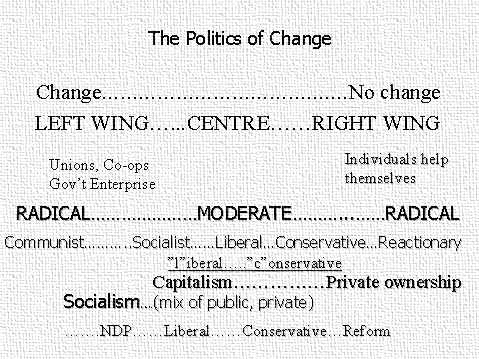
The above is an attempt to underline the continuity from Left to Right as central in political attitudes toward Change. Socialism and Capitalism, far from being mutually exclusive, are normally grouped as "market economies", with Fascism and Communism grouped as Command Economies. Socialism, or Social Democracy in its most common form, can be considered as "capitalism with a human face". This approach helps to put debates about the place of government in their lives in a perspective students can understand. (17) I made a point of emphasizing to students from time to time a central fallacy of argument that will crop up in almost any political and social debate: someone will invariably divide an issue into right and wrong, good and evil, and attempt to appropriate the high ground and force all dissenting views into a box wherein they are not merely mistaken, but evil. From the Reformation through the French Revolution, Communism, and Fascism, to political correctness of the Left and Right, this has meant that true believers and activists have been able to justify eliminating dissenters rather than merely contradicting them. This is the meaning of the Intolerance…..Tolerance theme in our 4Ps overview of Historical Change.
Socially relevant comment in the Teaching of History
Categorizing social questions in terms of good or evil, and right and wrong, is part of an authoritarian proclivity which always assumes that there are only two sides to a dispute, and that if anyone disagrees in one particular, he can be expected to disagree in most others. This malignant assumption runs through modern culture like a …. I was going to say "disease", but this would be to fall into the behaviorist mindset which has taken over twentieth century social science. Behaviorism conditions our views on punishment, animal rights, abortion, and censorship, to pick only a few issues at random, and aggravates a general tendency to manipulate the rights, actions and ideas of others, whether through indoctrination, censorship or regulation.
Together these assumptions permeate a broad range of causes, whether fanatic or merely activist, progressive or reactionary, generous or mean-spirited. We have, in less than a century, gone from the enlightenment of seeing that genetic and environmental parameters influence activity, and hence qualify individual responsibility, to effectively holding that punishment is equivalent to revenge, and can only be resorted to if it causes people to change behavior, either through deterrence or reform. We then wonder what went wrong when paroled sex offenders murder, and never ask whether a murderer or violent criminal might be held responsible for second or multiple murders, and so make a case for the death penalty in such cases. Social Darwinism did not expire with the dictatorships of Hitler and Stalin.
History is permeated with opportunities for raising socially relevant questions, so much so that, unless a teacher is careful, she could find herself doing nothing else. Part of the rationale for my own thematic approach to organizing historical material is that it allows a logically consistent framework to work in important linkages. It should be clear, then, that the study of history is rich in events which fall into the Intolerance--Tolerance continuum and which allow endless connections to be made with student experience. The themes of Power and Change are there in order to make social comment relevant, no matter where one is in the journey through the historical record. Indeed, there are some advantages is dealing with these issues in a historical context, where students--not to mention administrators and other teachers--will feel less threatened.
There is no point in the study of History if its lessons cannot be brought to bear on student experience. We cannot, however, risk teaching over our student's heads by trying to develop an internally consistent General Theory of History, even if such a thing were possible. Historical interpretation is as much art as science, but we can impart a sense of the general tendencies, and the key causal factors or engines, which will yield interpretations avoiding the arbitrary and fortuitous without doing injustice to the truth.
For example, I was fortunate, if that is the right word, in covering both Agincourt and modern military logistics (World War I trench warfare and Panzer tactics in World War II) at the time of the recent Gulf War. Students could appreciate the concept of a fixed infantry position, and speculate on why it failed the Iraquis and the Maginot Line. (The Iraquis lacked the bottleneck Henry had created, and so could not force an assault at a predictable point. In any event, the arrows in the Gulf War were owned by the offence.) The panzers went around the fixed Maginot Line, or punched holes at the weaker points, as Schwartzkopf was able to do. Both Rommel and Schwartzkopf knew that success turned on ignoring the forward elements and striking deep into the rear to disrupt reinforcement and logistics.
The position of women and minority groups can also create controversy, but such issues ought to arise within our consideration of Power and Change, and never replace the teaching of history. My final teaching assignments were enlivened by some interesting anniversaries- the 400th of the Armada in 1988, and the 500th of Columbus, in 1992, which have raised in some quarters the question whether Columbus had any right to colonize New World, not to mention any number of grievances from the politically correct about the European treatment of a people who had a fundamental right to be left alone. Now the movement seems to be toward avoiding "Euro-centered" history and fragmenting Social Studies into a miscellaneous grab-bag of ethnic and feminist history and customs, and their related social concerns.
But a sense of history ought at least to enable us to avoid Romantic nonsense. Conquest is nothing new, and the European newcomers to the New World were neither more nor less cruel than the indigenous populations. The native cultures need not be idealized: they were generally subsistence economies dependent upon hunting and fishing, precarious livelihoods from the beginning of time. (18)
They lacked, in common with other non-European and nomadic cultures, any intrinsic impetus to Change, and this sometime appears to a Romantic mentality to be paradisical, and leads to an assumption that early North Americans were somehow more in tune with their environment, immune to the technological rape of nature characteristic of Europeans and their descendants around the world.
Had native North Americans been around long enough, they would certainly have moved along the same road traveled by Europeans, although just how far is problematical. While America and Europe shared the stimulus to invention of a harsh climate, European supremacy owed much to geographical positioning along major migration and invasion routes, which forced them to adapt to constant pressure from other cultures. Not only did this spur technological change, it altered the nature of European warfare, a key cultural extension of the drive to survival and Power. From the horse peoples (Huns, Mongols) they acquired a warrior ethic, reinforcing their practical Roman tradition, which led them from a conception of warfare as a ceremonial and limited cultural expression to a conception stressing decisive victory and permanent solutions to national rather than tribal questions. From the Arabs Europeans learned the value of ideology as a military motivational device, and this in turn led to an identification of an individual's destiny with that of the national state. Given their geographical isolation, however, native North Americans are more likely to have followed the Chinese and Japanese in limiting Power and Change within age-old cultural values, and thus, like the Chinese and Japanese, they would have remained vulnerable to social revolutions inspired by more technologically advanced cultures.
Nevertheless, native and European cultures had elements in common, too. Native populations also had a significant impact on the environment. In common with various Asiatic and European peoples, who first saw the horse merely as a source of food rather than as a key to conquest, Amerindian populations already possessed a hunting technology sophisticated enough to exterminate the horse, along with the giant bison and three species of mammoth, within 1000 years of their arrival on the continent. The Maoris of New Zealand killed off eighteen species of birds in a similar timespan. (19) There is no need, therefore, for a teacher of history to talk as if native people have somehow inherited a gene for protection of the environment, as if they would not have done exactly as we did had our situations been reversed.
There is ample room within the framework of historical study to address social concerns in a meaningful and interesting context, without abandoning the legitimate academic ideal of furthering intelligible historical explanation, and relying on it as a key building block in the quest for literacy. However, a detailed introduction to ethnic studies, together with serious initial introductions to such important contemporary issues of teen sexuality and violence toward women, might best be done in the middle school years with pre-teens, where the exposure might do some good. Shaping adolescent character at an early stage would be an improvement on the current practice of offering a Grinder preview of general history in grades Seven and Eight, with a tendency to weaken the status of History as a discipline by associating its study with a dismal recitation of dates and events. The rich potential of historical studies can be realized better on the secondary level with more mature students, although in-depth treatment of ancient history can be done as early as Grade Nine, with the adaptation of the early horse to the chariot, which provided the power base for the dominance of the Assyrian, Babylonian and Egyptian civilizations.
Debates as to whether primitive or European culture were superior are irrelevant in any event: even if Columbus had stepped ashore with a battalion of sociologists, social psychologists and activist lawyers, the outcome would have been the same in the long run--the native culture was doomed to adapt to the European. The moment a rifle, hammer and nails, knives, saws, and horses were available for trade, divisions of rich and poor, and the trappings of power and government, would have been injected into native culture and changed it in the direction of the European model. The best anyone could have done was to smooth the transition. Blame Europeans for racism and injustice it you will; but expect native people generally to adapt to the realities and avoid the trap romanticising the past, as if it were possible to turn back the clock. Native people have the right to an opportunity to preserve a viable culture within the surrounding European reality, and for that they will need a deep understanding of both traditions.
The argument that Europeans had no right to invade North America is absurd on two counts. First, this would assume a natural native right to deny the logic of evolution in European society: Europeans would have been required to remain mired within the darkness of feudalism, with its rigid divisions of haves and have-nots, and to give up the pursuit of rational knowledge and a betterment of the human condition. There is no natural native right to be immune from evolution and change in social organization no matter what the implications for other groups. Secondly, North America has always supported a huge population, both at home and through its exports abroad. The needs of others is another good reason to deny that the sparse pre-Columbian Amerindian population had a natural right to the exclusive occupancy of North America.
The debate over whether Columbus was the first to discover the New World is another good example of hollow historical debate. Eric the Red, travelers from China or Scotland, or Basque fishermen stepped ashore on distant landfalls, but they couldn't discover anything. Discovery implies an event that changed history by opening up new markets and releasing huge new economic and political energies; it implied a culture which knew enough science and geography to realize that there was something altogether new between Europe and Asia--as Bronowski observes, it was the Old World which went looking for the New, not the other way around. In this sense, only a European could have discovered America, regardless of who stepped ashore first.
The impact of the European technological advanced culture on the primitive civilizations of the New World and Pacific would have been devastating in any case, even given the best of intentions. Haworth, in Tahiti, gives a vivid picture of how fragile primitive cultures are, and Bronowski has something of interest to say as well. To understand the scale of Change faced by native populations, and appreciate why the effects were so consistently negative, one does well to consider the position Europeans would be in after a thermonuclear war, when they would have to adapt to an earlier and altogether foreign neo-stone age technology in order to survive. Most people would die of starvation and exposure long before the adaptation took. Considerations of this type afford a better approach to tolerance than the Grinder habit of preaching at students about racism, or throwing a bone to minority groups by injecting artificial and isolated chunks of minority history and culture. I preferred to compare the misery and drunkenness of Manchester and Liverpool during the early years of the Industrial Revolution with the social problems of native people, the better to dramatize the traumatic effect of Change in history on all races.
It is a shallow view of democracy to suppose that we are obligated to sacrifice continuity and understanding in order to allot token time to significant racial groupings in our classes, at least at the high school level. All that invites is memorizing trivia about Roman atriums, Iroquois longhouses, Peruvian temples, teepee rings, and Eskimo igloos, for no better reason than that we have reached a given year (the world in 1608) and must give a ritual nod in the direction of various visible minorities by de-emphasizing "Euro-Canadian" attitudes. This only reinforces the Fact One to Fact 849 fixation, and is a surrender to the temptation to grasp at magic wands in order to buy off a restive public and preserve the anonymity of the Compact. There is a real danger that the teaching of History as an academic discipline will be drowned by an assortment of political agendas.
A teacher has to make the necessary connections between concepts, events, and personalities. Unless he is working from a deep well he may not be able to exploit the AV resource effectively, or he may need guidance from others who have the necessary background and experience. This is precisely what he is least likely to ask for, or get. The young teacher will begin the search for autonomy almost at once, and this will not encourage innovation. As ever, the reality of the Compact lurks in the background, aggravating the natural ego and insecurity of the beginner.
*************
It is now possible to pick up the chronological thread and trace the process of Change in the Twentieth Century through the two great wars, the Depression, the Cold War and dawn of the Global Village with its technological and information networks. I liked to give a social history of the Twenties and Thirties, relying in part on Lowell Thomas Remembers as well as the many excellent programs detailing the rise of Communism and Fascism and the era of total warfare. I would even suggest that a feature-length film might be in place here to add a human dimension to the study of history: one of my favourites was the Warren Beatty production of Bonnie and Clyde which provided, an excellent period piece on the life and values of Great Depression America, which determined the shape of the world my students were born into.
My students ate up the AV centered approach; my colleagues simply ignored it.